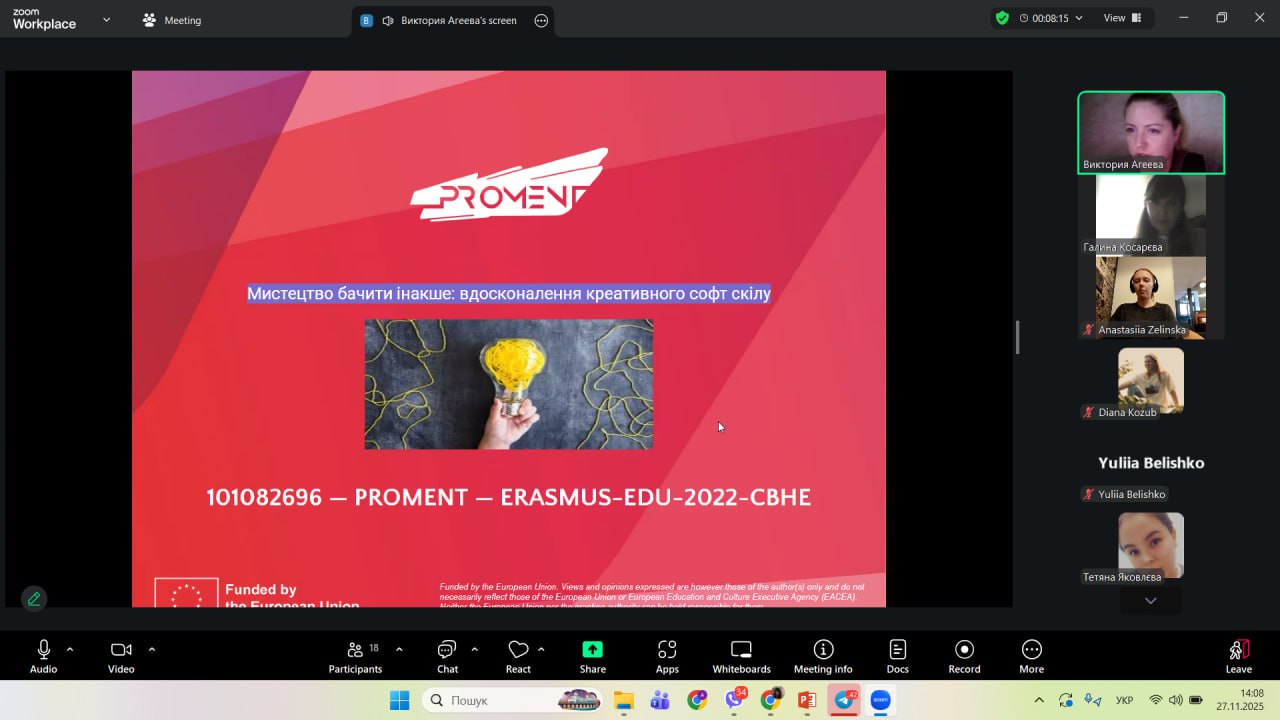
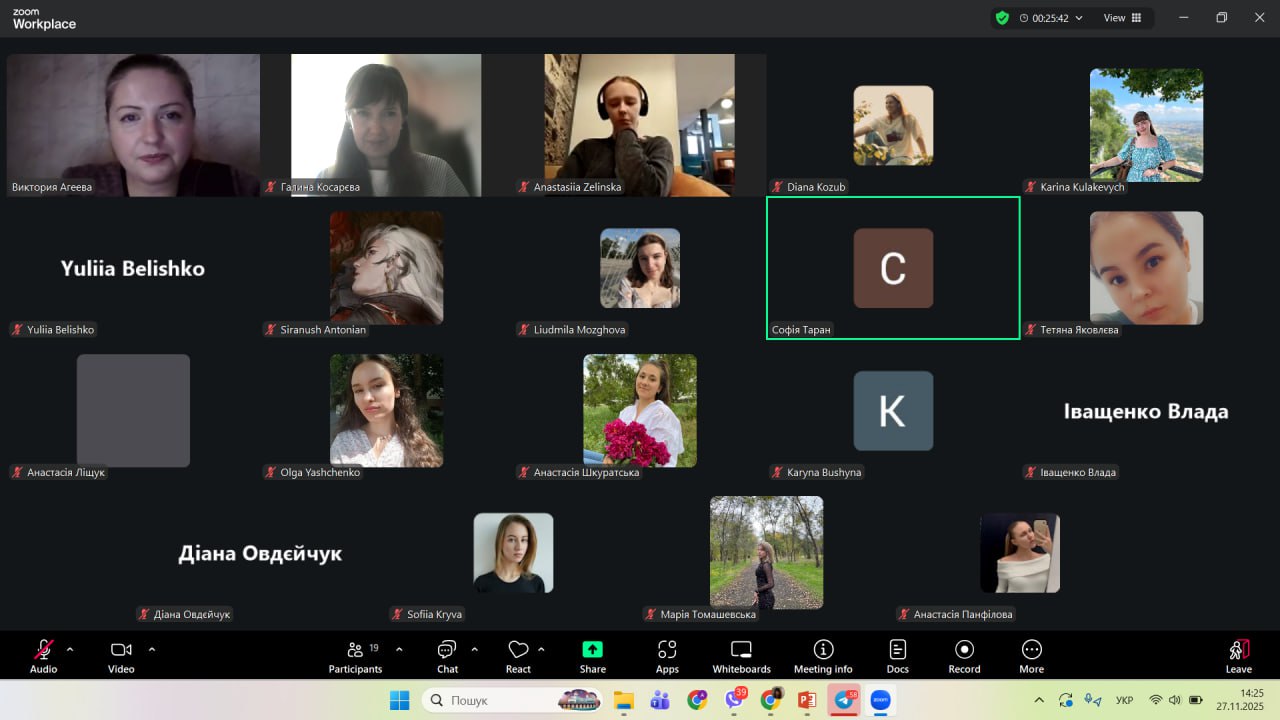
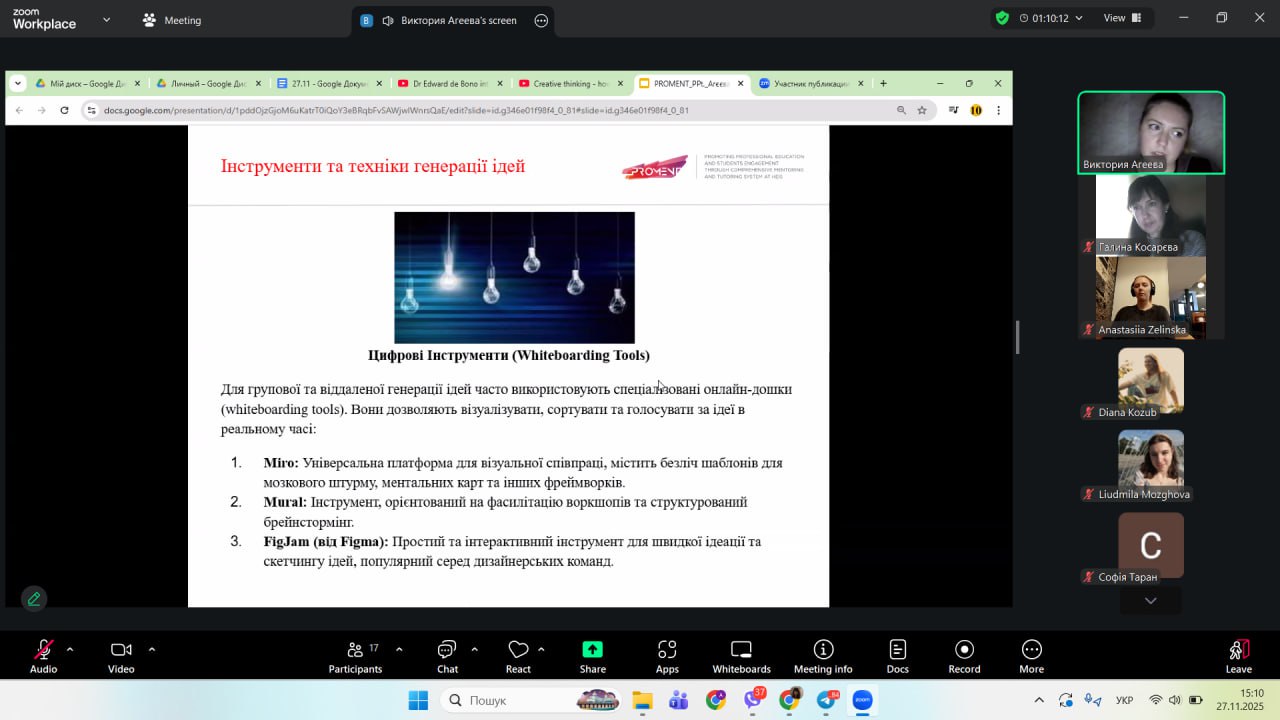
On November 27, 2025, within the framework of the implementation of the EU Erasmus+ project 101082696 – PROMENT “Promoting professional education and active participation of students through the formation of a comprehensive system of mentoring and tutoring in higher education institutions” under the scheme “Mentoring of young teachers”, the training “The art of seeing differently: improving creative soft skills” was held online.
The mentor was Viktoria Ageeva-Karkashadze, Head of the Department of English Philology and Translation, Candidate of Philological Sciences, Associate Professor of the Department of English Philology and Translation of Petro Mohyla National University of Chernivtsi. The moderator of the event was Halyna Kosaryeva, Candidate of Philological Sciences, Associate Professor of the Department of Ukrainian Philology and Intercultural Communication, and implementer of the PROMENT project.
The goal of the training: to teach participants to consciously apply methods and techniques of creative thinking to generate non-standard solutions, overcome mental barriers and increase personal effectiveness in conditions requiring an innovative approach. In general, the training was aimed at developing flexibility of thinking and the ability to generate innovative ideas to solve professional and personal tasks.
The objectives of the training were as follows:
- Diagnostics and awareness: analyze the participants’ individual thinking styles and identify their current “creative blockers” (stereotypes, fear of making mistakes, perfectionism) and show the importance of creativity as a key soft skill in the modern world and its impact on innovation.
- Training in idea generation techniques: provide participants with practical tools to activate the creative process (e.g., the six-hat method, the scramble method, SCAMPER, associative maps, TRVZ techniques) and teach them to use “perspective-changing” techniques (side view, role model) to get new ideas.
- Practical application: organize practical sessions on using creative methods to solve real cases and problems relevant to participants and teach them techniques for evaluating and selecting the most promising, even the most “crazy”, ideas.
- Creating a creative environment: to build understanding of the importance of a safe and supportive environment for creativity in a team and in the workplace, as well as provide recommendations for supporting creativity after the training (self-development, routines).
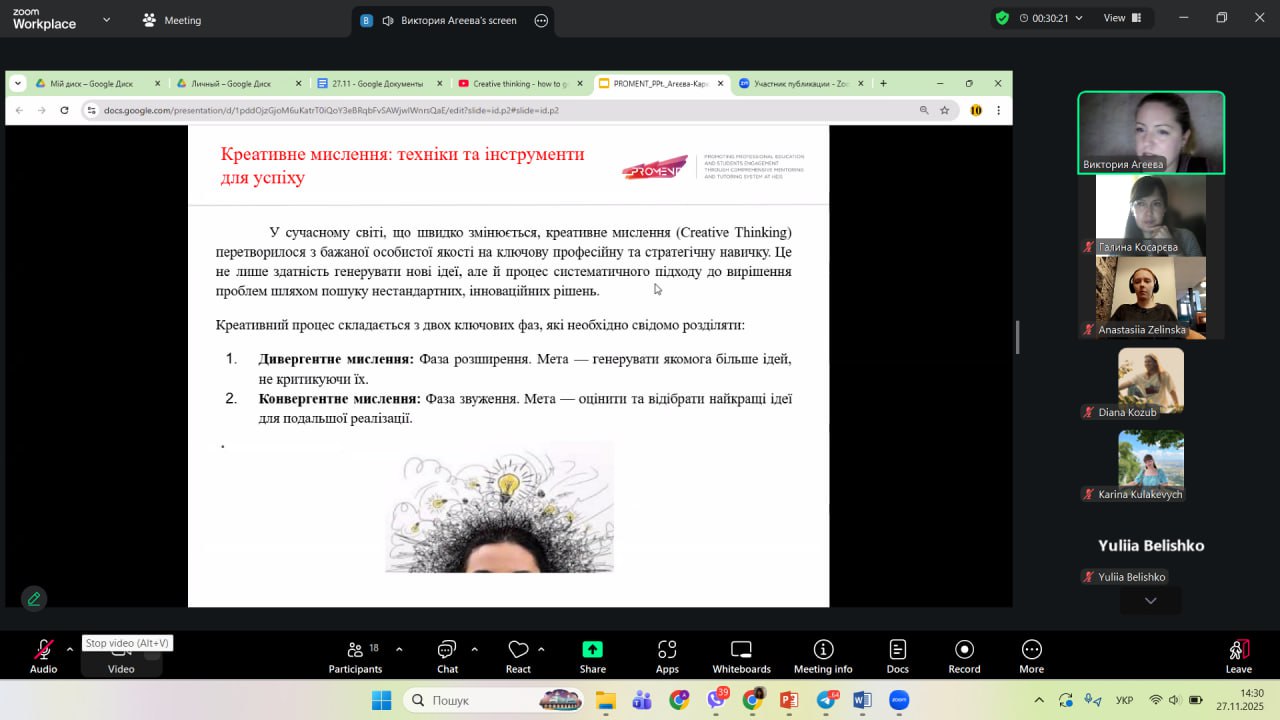
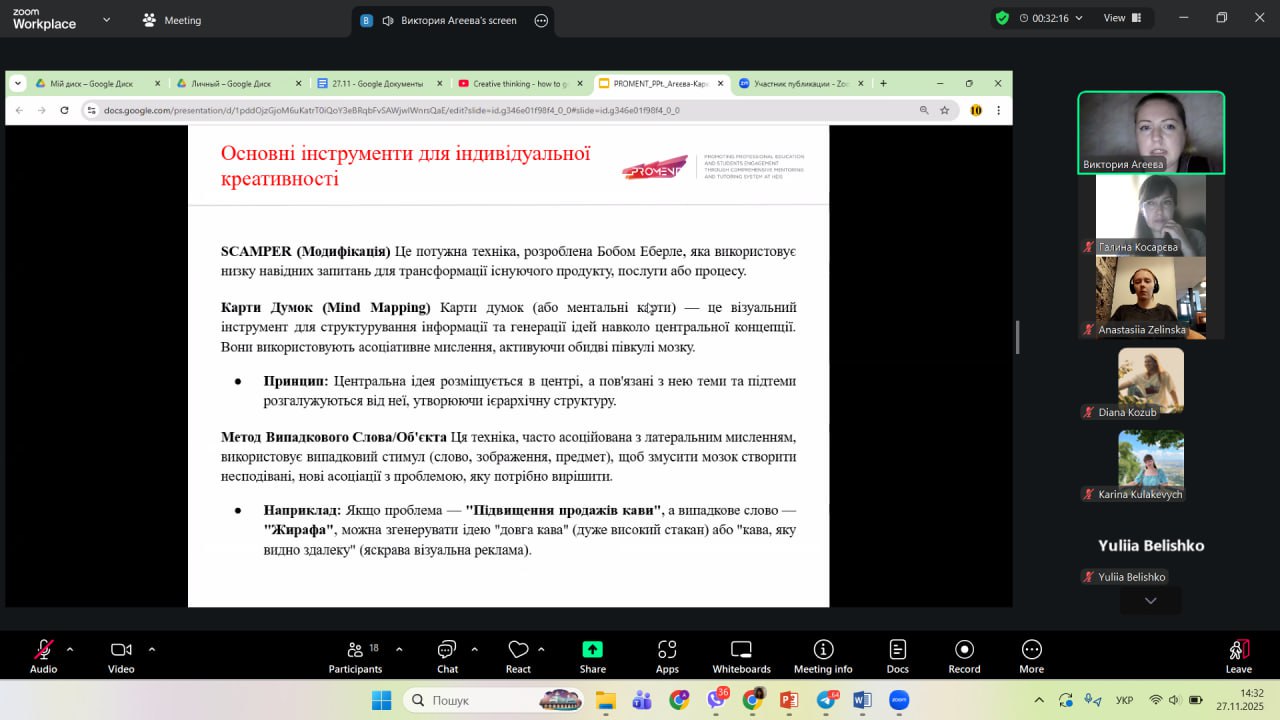
During the training, the mentor presented information about effective techniques for creative thinking and idea generation (e.g., SCAMPER, lateral thinking, focal object method); mechanisms of creative barriers and ways to overcome them; knowledge about the psychology of creativity and the phases of the creative process.
Skills acquired by the mentee during the training:
At the Skills level :
- Participants will be able to independently apply 2-3 key techniques to solve complex, non-standard tasks.
- They will acquire the skills of changing the paradigm of thinking (switching perspective) and looking at the problem from different angles.
- Improve team idea generation skills (brainstorming facilitation) and constructive criticism.
- Will be able to turn criticism and unsuccessful ideas into new opportunities.
3. At the level of attitude:
- Participants will have less fear of mistakes and new approaches ( “This is just an experiment, not a failure” ).
- Openness to unusual, “crazy” or controversial ideas will increase.
- A proactive position will be formed regarding the search for innovations and process improvements.
We would like to thank the esteemed mentor, Ms. Victoria Ageeva-Karkashadze, for the relevant and practice-oriented training, and the student mentees for their interest in the topic of the event, their motivation, and their involvement in it.